What was your background before this role?
Before joining the Driver and Vehicle Standards Agency (DVSA), I spent several years working in the banking industry—starting with high street banks before moving into the world of international banking. London became my main base, but the job took me all over the world as I travelled to meet clients face-to-face. At the time, the reliability of the internet wasn’t what it is today, so building relationships in person was essential.
My role involved working extensively with computers: setting up spreadsheets, checking interest rates, and monitoring foreign currency exchange rates. It was a fast-paced environment, but alongside it all, I always had a deep passion for motorcycles.
Life took a new turn when I became a single mother, and with that came a career change. I joined the DVSA as a car examiner, and within a few years progressed to become a motorcycle examiner—a role that aligned perfectly with my long-standing love of bikes. Eventually, I moved into the CBT Team (Compulsory Basic Training), where I’ve been proud to contribute for the past 8 years.
“Every day brings something different, and that variety is a big part of what makes the job so rewarding. […] Simply put, it really is the best job!!”
What do you like most about your role?
Being part of the CBT Team is, as every member will tell you, “It’s the best job within the agency.” And honestly—who wouldn’t love getting paid to ride a motorcycle?
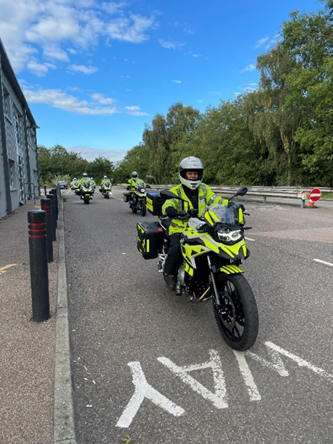
We spend our days out on the road, riding all year round. There’s no such thing as bad weather – only bad clothing, and that’s something we never have to worry about. Every day brings something different, and that variety is a big part of what makes the job so rewarding.
But the real highlight?
The independence. We’re trusted to manage our own workload, plan our own diaries, and be able to balance both work and home life. That kind of freedom is rare – and we know how lucky we are to have it.
Simply put, it really is the best job!!
What makes our team culture unique?
For me, what really sets our team apart is the balance we’ve managed to create between professionalism, genuine care, and everyday practicality – and our passion for motorcycles. Because we’re such a small group which is spread across the UK but closely connected – we’ve built a culture where every voice genuinely matters. There’s no sense of getting lost in the crowd: we all see the impact of each other’s work, and we support one another because we know the pressure points of the job.
As a woman in the CBT team, what stands out most is the respect and psychological safety we’ve created together. I never feel that I need to “fit into a mould” to be listened to. Our conversations are open, honest, and often full of humour, and we’re comfortable bringing our individual personalities into the space. That authenticity makes collaboration easier and decision making quicker, because we aren’t navigating egos — we’re just working together.
We also have a unique blend of strengths: different backgrounds, different regions, different ways of thinking — but a shared commitment for doing the right thing for road safety and to motorcycle training. Even though we’re dispersed, the sense of unity is stronger than in many teams that sit in the same building every day. We check in on each other, celebrate small wins, and pull together when things get tough. It creates a team culture that feels not only productive but genuinely supportive.
Overall, our team is unique because it’s built on trust, respect, and the understanding that we’re all real people behind the job titles. That makes a huge difference in how we work — and in how we feel about the work we do.
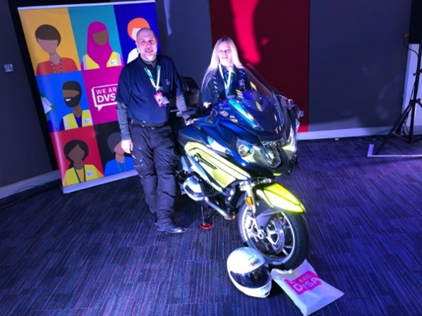
How has DVSA helped you to upskill?
During the initial recruitment process, DVSA provided clear guidance, useful links with structured support that helped during all the levels of the recruitment process. It set the tone for what would become a career filled with learning and development opportunities.
Training to become a car examiner was intense, but the training staff played a huge role in making it achievable. They were knowledgeable, supportive, and always willing to help, which gave me the confidence and capability to complete the course and start my career with the DVSA.
When my line manager later encouraged me to apply for the motorcycle examiner course, I found the training to be equally challenging, but again, incredibly rewarding. The trainers brought with them a wealth of expertise and practical experience, and their encouragement made the demanding nature of the course feel manageable and worthwhile.
Joining the CBT team followed a similar pattern, but this course stood out as the most enjoyable for me. The role covers such a wide range of responsibilities, and the training reflected that — bringing together many different learning styles and skill sets. It was varied, engaging, and gave me a deeper understanding of the wider impact of the work we do.
Once I was part of the CBT Team, DVSA continued to invest in my development. They offered us the opportunity to complete an external mentoring qualification — a recognised and valuable course. Importantly, we were also given the time we needed to complete all the coursework properly, which made a big difference to the learning experience.
Alongside this, there are a wide range of Civil Service Learning courses, including several mandatory modules. These online courses offer ongoing opportunities to grow skills, refresh knowledge, and stay up to date.
A day in my life as a CBT Examiner at DVSA.
No two days in my role are ever the same. I might be working from home, carrying out standards checks, visiting sites, or assessing instructor qualifications. Today, I thought I’d share what it’s like to conduct a DAS (Direct Access Scheme) instructor qualification assessment.
My day begins with travelling to the approved site — in my case, that’s in Gillingham, Kent. Once I arrive, I set up my workspace, carry out the necessary checks, and prepare the assessment reports. I then complete the bike checks and wheel the bike into the agreed area, ready for the assessment.
DAS assessments are always one-to-one. When the instructor arrives, I greet them, run through the building’s health and safety information, and give them a moment to settle in with a drink. At 08:30, the assessment officially begins.
I start by explaining how the morning will run, as a DAS assessment takes half a day. We then head outside to the bike, giving the instructor a few minutes to familiarise themselves with it. The first 3 sessions take place on site, where I act as the trainee. It’s the instructor’s job to recognise and fix any issues that arise.
Once those sessions are complete, I explain the next 3 modules, which take place on the road. The instructor is given time to prepare while taking a short break. Then we head out for the road ride. Since they may not know the area, I give directions over the radio. Again, I ride as a trainee, and the instructor must guide me and resolve any problems that occur.
After about an hour and a half, we return to the site. The instructor takes another break while I score the report and prepare the outcome. I then deliver the result. After lunch, the same process is repeated for the afternoon assessment.
At the end of the day, I pack up, travel home, and write up the reports in detail.
Our roles offer comprehensive training and the chance to make a real difference to road safety.
Visit Civil Service Jobs to view current vacancies, or sign up for Jobs at DVSA email alerts to be the first to hear when new positions become available in your area.